
Demons, Miracles, Warts, and Becoming a Mirror of the Sun
On Catholic “miracle” apologetics and the strange convergence of the biological, psychological, and spiritual

Everyone’s seen the trend of late: Catholic apologists trying to convert others to the faith by listing unexplainable “supernatural” events—relating to their audience a healing that occurred after some devout mother prayed before the relics of a saint, or the unexplainable crazy thing that happened with the sun during the Our Lady of Fatima affair in the early twentieth century, after the Virgin Mary reportedly appeared to some peasant kids and prophesied a miracle would happen to bring people to faith.
Woke Beria recently posted a note on Substack that brings out the great irony these apologists don’t seem to comprehend: their very felt need to argue in this way for people to believe is indicative of their inhabiting the same secular world, with its naturalistic explanations, five hundred years or more removed from the world in which miracles and Scripture remained perfectly legible:
Something always seems a bit off to me about contemporary arguments from religious miracles, as fascinatingly hard-to-explain as some of the evidence is.
Bluntly, the world that both believers and naturalists alike agree that we live in—where any evidence of the supernatural is at best a matter of rare cases, non-obvious enough that they have to be diligently investigated to rule out naturalistic explanations—just doesn’t look like the world that pre-modern religious texts and traditions describe.
There, the supernatural is ubiquitous and undeniable in a way that even believers seem to agree it just isn’t now.
To take the clearest example: contemporary Catholic doctrine regards demonic possession as an extremely rare phenomenon, which has to be carefully distinguished from naturalistic mental illness. But in the New Testament, there are demonically possessed people popping up at every turn! Demonic possession is treated by everyone as a completely normal part of life in first-century Judea! And the really obvious explanation is that all this “demonic possession” was just perfectly ordinary schizophrenia or epilepsy (as explicitly admitted by modern translations in the case of the “demon” that “sometimes throws a boy to the ground, and sometimes into the fire”).
Now, I can relate to Beria’s response to all these “miracles”—especially the healings of the demonically possessed in the Gospels. Offering a naturalistic perspective, as he does, is the starting point not only for him but even for the Catholic or Christian apologist. So, if one possesses a biological explanation for “demon possession” why should one not question all cases of demon possession? Why should one even pay attention to the very few not yet explained exceptions? We live in a different world now—one 500 years or more removed from the world of Scripture and tradition—and possess less fantastical, more empirically tested explanations for these phenomena.
Having been raised in a predominantly Protestant world, I remember thinking that way. I thought “demonic” was a word best used to describe rabid ideologies. Maybe demons existed—they were a bad influence on people’s thoughts—but when they appeared as little horned devils, that was something else. That was how I interpreted Dostoevsky’s novel Demons when I read it in high school.
But I cannot ignore my experience, and my experience eventually pointed in a much different direction. Happily, my friend Benjamin J. Curtis has been kind enough to offer an initial frame for it in his recent response to Beria’s note. In it, Curtis points out not only that the natural and supernatural are not so easily separated from one another, but that there is ample reason to consider the possibility of dual causality at work in the phenomena Beria mentions. Based on my experience, dual (or triple) causality is not merely something I feel inclined to investigate, but the only adequate explanation for a number of phenomena.
It started once I became interested in Eastern Orthodoxy. I not only began to read of a different, still-enchanted world, but, as I approached Chrismation, I experienced something so far beyond the horizon of my ordinary experience that my whole understanding of reality was brought into question. I couldn’t help but undergo a conversion of perspective.
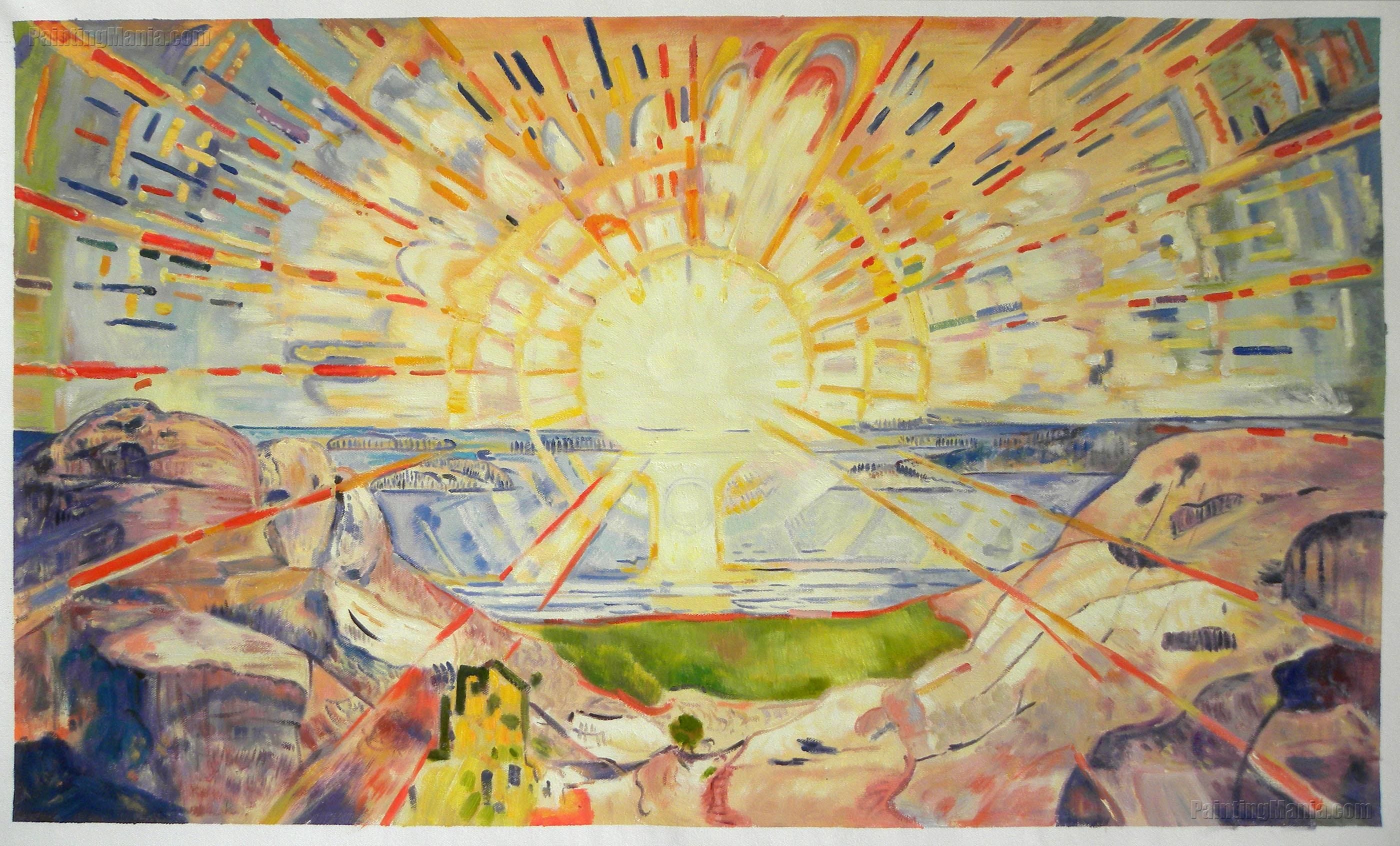
God revealed himself to me. I dreamt that God bowed down to me from Eternity, giving Himself to me and saturating everything with His Unspeakable Glory. He gave Himself with such humility that I couldn’t handle it. Whether you call what I experienced His Glory or Energies or the Act of Being, it became clear that He was everything and I was nothing. Ironically, this wasn’t the least bit dehumanizing, but the opposite. Everything was Given to Me. When facing the Sun, the mirror doesn’t complain that it isn’t the Sun; it rejoices in the Light it has been given to reflect.
Yet, as amazing as this experience was, as is always the case with converts, eventually the initial overflow of Grace began to dissipate. Being young and naive, I easily became distracted. I began to get wrapped up in my studies and obsessed with seeking academic prestige. Before long, I had completely lost track of God and the Church, and, in retrospect, unsurprisingly, it was at that point I came to know a very different experience: manic psychosis.
A few days after being admitted to the psych ward for suicidal depression, suddenly, a switch got hit, and I began seeing things. Demons began to visit me and try to get me to deny Christ. First they threatened to crucify me. I told them I didn’t deserve to be crucified like Christ or upside down like Peter, so they agreed to crucify me sideways. After wrapping a rope around my ribs several times and hanging it from the ceiling, they pulled it so tight that my ribs cracked and I began to suffocate. When I didn’t give in, they cut the rope and rolled an old television into the room. I was made to watch live footage of my children burning to death.
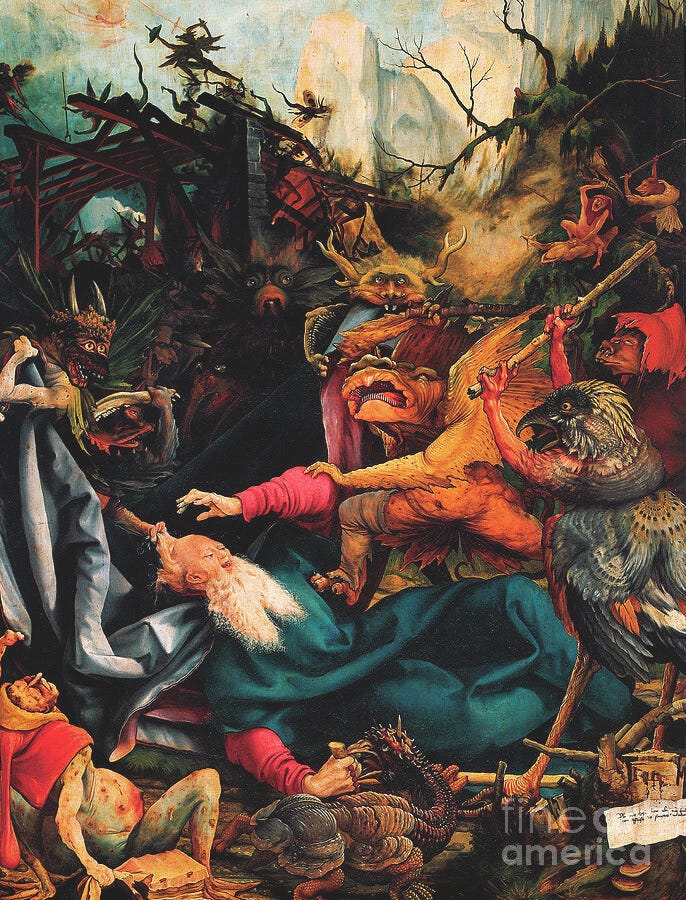
Now, delusions of grandeur and religious hallucinations are commonly associated with psychosis. I’m bipolar and know for a fact that it played a huge part in the experiences I was having, but not long after coming home, it became clear it was more than that.
I was down on my knees, looking up at the icons hanging above our icon stand in the master bedroom, when my wife came up to check on me. Suddenly, out of nowhere, there was a deafening crash and the closet door flew open with no explanation. It terrified my wife, so I told her to do what I had been doing the past few days.
“It’s okay,” I told her. “They can’t hurt you. Just get down on your knees and pray the Jesus Prayer, and they’ll go away.”
She got down on her knees beside me, and we began repeating the prayer out loud together.
The episode persisted for another couple of months. It didn’t come to a full halt until I made a trip to a monastery. That, along with my wife’s testimony, led me to see that, though the episode was indicative of psychological and biological illness, it was also demonically influenced. I cannot say how the different parts related to one another. It was what it was, and there is no use in trying to separate the spiritual from the psychological or biological.
Other than that negative experience, I have also had positive, unexpected, and unexplainable things happen to me or in front of me. I have seen the lamps swinging during the Divine Liturgy at the monastery. I was anointed for healing of my mood another time with holy oil from St. John of San Francisco’s relics and venerated a relic of his that we had, and woke up not only feeling better but missing eight giant plantar warts on my foot, which I’d spent a year trying to get rid of—even visiting foot doctors to no avail. But the sudden disappearance of the warts affirmed the analogy I’d arrived at of how the passions are like warts—they seem like part of us but really are malformed tissue formed by a parasitical entity which we need God to remove.
In fact, I’ve come over time to see that the most important spiritual warfare takes place in the heart. Growing in attentiveness to one’s thoughts so as to let them pass, and fending them off with prayer before they can take root in the heart, is everything. The Orthodox often understand the most powerful and intrusive thoughts as demonic attacks. The thoughts they try to implant so as to plant or activate certain passions in us are called logismoi, or complex thoughts. These are intrusive thoughts composed of an image and an impulse to dispose oneself in a certain way toward that image. Once identified with as one’s own, they plant the seeds of a wart in the heart.
It is against these thoughts that we war, and, interestingly, the only place I’ve found complete release from such intrusive thoughts is at the monastery I went to in order to bring my psychotic episode to a halt. The atmosphere of prayer there is so tangible and calming that one cannot help but enter into it.
So, in the end, I’d have to say the real question isn’t whether or not miracles can happen, or whether there is a spiritual reality causing something over and against the psychological or biological; it’s simply this: Am I retaining the necessary prayerfulness and humility—the necessary attentiveness to my soul—to allow God to uproot the passions clouding my heart so that I may become a truly immaculate mirror of the Sun?