
When the Other World Becomes Ordinary: Orthodox Burnout
Orthodox burnout, convert novelty, and facing up to our Self

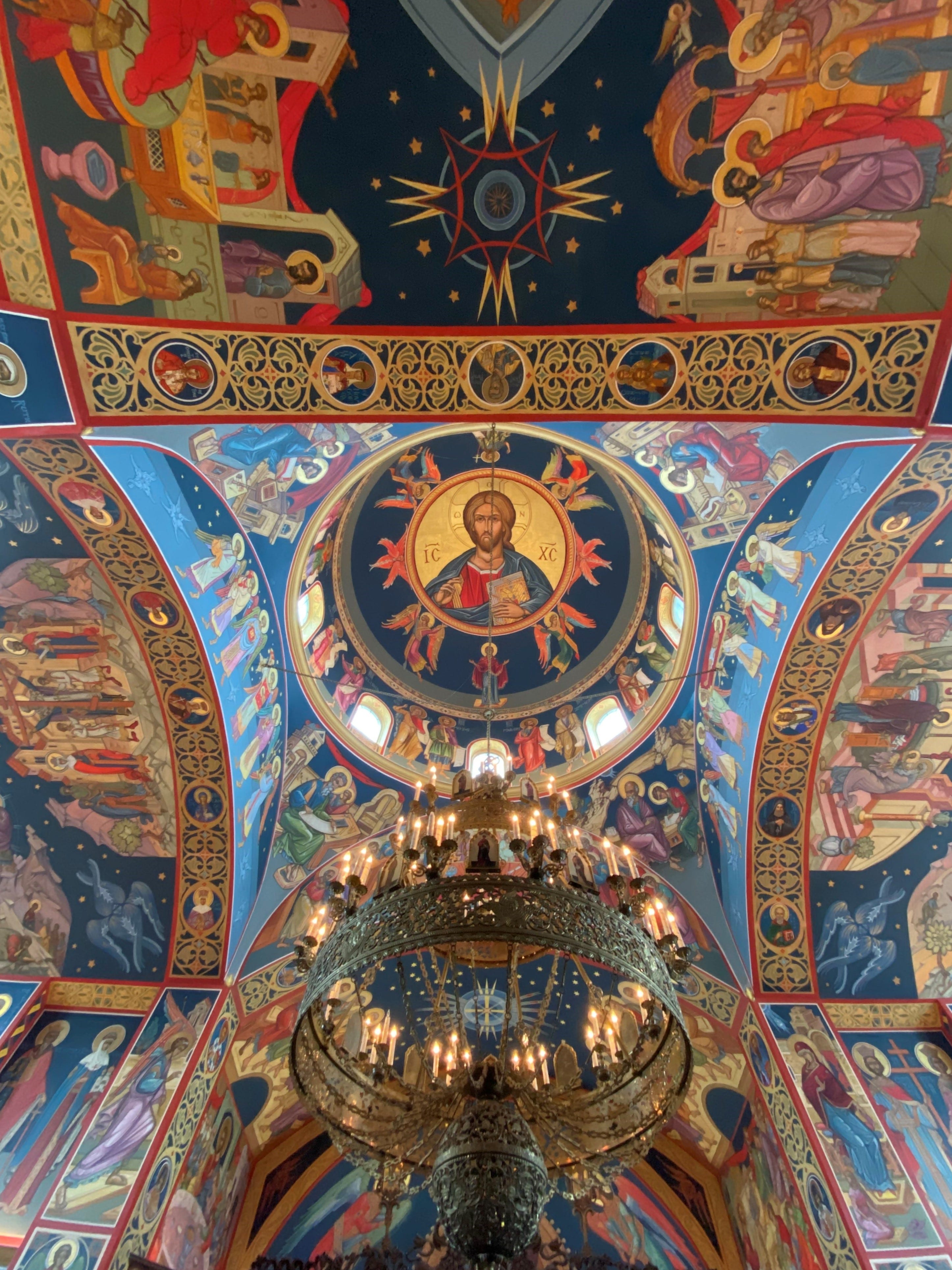
The first time I entered an Orthodox Church, it was like I’d suddenly slipped into another world. This place knew no such thing as the Reformation or Counter-Reformation or the Enlightenment. No, as the deacon made his way round the nave swinging his censer at everything and everyone, flooding the church with incense, it was clear this was a space which had never fully left the Eastern Roman Empire of Late Antiquity.
Icons of saints with gold-leafed halos and scenes from the Bible with apocalyptic dimensions covered every wall and the ceiling and were inset in the finely carved icon screen separating the parishioners from the altar. Strange tones that seemed to emerge from somewhere else issued forth from the mouth of chanters. There were no pews. Everyone stood. When the priest made his way into the nave, he stood up front, offering endless supplications, and each time he finished the whole congregation responded with, “Lord have mercy.”
All in all, the Divine Liturgy felt like it placed one before an infinite Mystery, a God “more spacious than the heavens” and yet who, as the icon with these words written round it showed, was born of the Theotokos, the Virgin Mary, to become incarnate in time and space. I had been attending an Anglican church at the time, and what they did on Sunday suddenly began to feel like it was play-acting.
Now, don’t get me wrong—I do not mean to demean the Anglican church, as it had provided me with some benefit—but rather to highlight the otherness of the experience of attending the Divine Liturgy. The whole habitus I had entered seemed to be witnessing to something Other; in fact, it could only be properly understood as such.
Only there could the Eucharistic Canon make sense:
It is meet and right to sing of Thee, to bless Thee, to praise Thee, to give thanks to Thee and to worship Thee in every place of Thy dominion. For Thou art God ineffable, inconceivable, invisible, incomprehensible, ever-existing and eternally the same, Thou and Thine only-begotten Son and Thy Holy Spirit. Thou it was who brought us from non-existence into being, and when we had fallen away, didst raise us up again, and didst not cease to do all things until Thou hadst brought us up to heaven and hadst endowed us with Thy Kingdom which is to come. For all these things we give thanks to Thee, and to Thine only-begotten Son and to Thy Holy Spirit; for all things of which we know and of which we know not, whether manifest or unseen; and we thank Thee for this liturgy which Thou hast found worthy to accept at our hands, though there stand by Thee thousands of archangels and hosts of angels, the Cherubim and the Seraphim, six-winged, many eyed, who soar aloft, borne on their pinions, singing the triumphant hymn, shouting, proclaiming and saying:
Holy! Holy! Holy! Lord of Sabaoth! Heaven and earth are full of Thy glory! Hosanna in the highest! Blessed is he that comes in the name of the Lord! Hosanna in the highest!
Having already become enamored with St. Athanasius’s summation of the Orthodox faith in On the Incarnation as “God became man that man might become God,” and with the Church’s non-juridical, therapeutic understanding of salvation, I was immediately ready to convert. Between the majesty of the world I had entered in the nave, and the general sense that I was home, I would have immediately become a catechumen if it had not been for the hesitation of my girlfriend at the time, but soon she was on board and desired to enter the Church as well.
After a year of catechesis, we were chrismated, and the year after that married. For a long time we were at all the services. We chanted at Vespers and Orthros, and it seemed as though this new world that had opened up before me was one I could never tire of. Part of this was because I received a saint’s portion of Grace upon entering the Church. And part of it was simply the novelty of the experience. Little did I know that I’d have to learn to face up to my own weakness and limitation, e.g. grow in humility, to gain the capacity to keep hold of the Grace given to me and not be affected by the fact that eventually going to Church would become just another part of my life and no longer stand out so as to attract me to it over other spaces. So, like any convert, after half a decade or so in—seven years for me—I came to a sort of impasse.
I got into the University of Chicago’s Divinity School where I could study with Jean-Luc Marion and I lost touch with everything other than my self. So concerned was I with my self and making it worthy of admiration that I didn’t even focus on my school work, but on finishing some scholarship or essay that would prove my intelligence to others. All day I’d wander the bookstacks in Regenstein Library reading a bit of this and then a bit of that trying to comprehend everything about everything, not realizing that I was simply evading any real encounter with my self.
Soon, without noticing it, I lost hold of the Grace that had been given to me. I stopped attending Church regularly and my prayer life disappeared. Everything began to revolve around me and my expectations and desire to become someone in the eyes of others, and I lost any concern for others or the ability to place their needs above my own. Self-denial no longer seemed prudent, and ever seeking to mount the pedestal I had built for myself of genius academic philosopher theologian, insecurities seemed to follow me everywhere. All it took was receiving my first B in grad school at the end of the first quarter and I had a nervous breakdown. I was so distressed that I impulsively tried to disappear. I began smoking pot all day until I’d gotten far enough away from my self and God and my children that it was no longer necessary to face the reality of my situation. Instead, I took the quarter off and then left U of C altogether.
Before long, I had a psychotic manic episode. It lasted three months and only ended after I spent some time at a monastery. After that I got so low I decided to do ECT and lost most of my memory. It took that and losing thousands of dollars to coke and amphetamines, crawling around on the bathroom floor for hours searching for just one more speck of white dust to snort, and nearly killing myself and my children by driving while out of my mind, before I began to realize that I had been seeking a solution to the problem of self in the wrong place. I had tried everything but becoming willing to face up to my self and my weakness.
Every time I thought I caught a glimpse of my self, my need to sustain a self greater than I was, was so great, that I wanted to commit suicide. I, after all, had not been there for my kids like I should have been. I did not provide for them like they deserved. I even lost the ability to stay home and care for them consistently. So, I began more than once to tie a noose for my self and eventually even began to hang myself before my wife broke into the bedroom and put an end to it. I thought the only way I could show my love to my kids was to get rid of my self. My wife could marry someone else. One who would provide for my children and who was worthy of admiration. I’d be doing everyone a favor.
I’m not sure what ended this state of mind other than prayer and the tears of my daughter, but eventually I came to realize I was needed here and after a time, that I was happier when I was still attending AA meetings and sober. Somehow, I finally was able to accept the suffering getting off of stimulants entails for me being bi-polar and the humiliation of returning to AA after so long a relapse.
I turned my will over to God and let go of any expectations to get better. For a long time prayer was arid and I suffered requiring ECT even to stay awake long enough to get out of bed, but eventually I was able to do more. I had to let go of my expectations and trust that God would provide when I put the needs of my family before my own feelings. Eventually, after a while of doing this, I started reading the hagiography of St. Paisios and St. Sophrony’s book on St. Silouan the Athonite and saw what I had forgotten and lost track of. The root of true spiritual growth and deification was humility. This was the prerequisite to be capable of love and entering into union with God, because God is love and God is humble.
Orthodox Burnout
Though it may not seem the same, I think the popularity of Edwin Robinson’s recent post on Orthodox burnout shows how common it is for a convert to come to an impasse like mine after some years in the Church. Robinson reveals how he has become disenchanted with Orthodoxy after years of trying to follow the rule of prayer and practice ascetic denial without seeming to make progress. This disappointment of his expectations leads to him turning outward in criticism of the Church.
He questions whether the saints who speak about themselves with such humility can actually believe what they are saying and not think they're better than everyone else. He questions whether Orthodoxy can be practiced in America because we live in a culture so foreign to Orthodoxy. He decries how his family didn’t fulfill his expectations by converting to Orthodoxy by now. But, at bottom, he is speaking of the same thing I was above. Robinson is focusing on the wrong things and evading the problem of self which has emerged after the novelty has faded and his expectations haven’t been met.
The problem, here, is he treats Orthodoxy as if it’s about performing rituals and succeeding at great ascetic feats and praying all the time.
But, if practice becomes rooted in the sense that “I do this rule, and therefore God will give me grace,” then it eventually becomes spiritually dangerous. Not because fasting, prayer, confession, and the Divine Liturgy are not important, but because our ego will perceive any growth provided by these as its own possession. Even spiritual growth can become the source of prelest and self-love when it is perceived as emerging from one who is primarily concerned with their own self and placing this self at the center of everything. Then when one fulfills their self-centered expectations they find reasons to admire their self and praise its accomplishments.
The important truth, it seems Robinson fails to see, is that the true majesty of God is not something to rise up to, but rather to descend into. God may be more spacious than the heavens, but He is also meek, humble, self-emptying, self-giving, and unconcerned with self-display. As Paul says, Christ did not regard equality with God as something to be grasped or exploited, but emptied Himself, to take on the form of a servant. Without ceasing to be what He is as God, He assumed our passible and mortal human condition, suffering even the humiliation of the Cross in order to give Himself to us and heal us, showing himself to be strong in our weakness.
This is why the saints speak of themselves as weak, dull, sinful, or the worst of all. This is the language of those who have actually encountered the majesty of the humble love of God. It is not that the saints are pretending to be nothing. It is that before the Mystery of God’s love, all self-importance becomes unbearable.
I haven’t personally reached the state of the saints or come close. But I know through experience that there is no moving forward in the spiritual life or in entering into union with God, without being able to see God gives more than we deserve and is completely self-giving and that the only proper response to encountering His presence, is accepting a bit of humiliation over our own lack of humility or self-giving love. This is hard. But only in conquering the self do we become ready to open ourselves finally to the unexpected and incomprehensible Life and Light of God.
This is right on. I also read Robinson’s post, but couldn’t put into words the problem with his thinking, from a true Orthodox perspective, without a lot of difficulty. You have done so beautifully.
Thank God you found your way back. Sounds like a rough road though. But it also sounds like Grace “super-abounded.”Thank God!
Excellent, thanks for this. For myself (now 12 years in the Church), I've hit more than one wall on the journey. I think there has definitely been a subconscious, or maybe even conscious belief, that I have to do all the things and I have to do them right and consistently (pray, fast, give, attend the services etc.) and if I do, then I won't struggle and I won't fail. But that goal of perfect participation and execution is a pipe dream (at least for me). Struggle and failure are unavoidable. There's a subtle but deadly pride in imagining I'm anything more than I am: a sinner. Two things I try to keep continually in mind are Fr. Thomas Hopko's 53rd maxim:
"Endure the trial of yourself and your faults serenely, under God’s mercy."
and a quote from Elder Sergei of Vanves:
"The purpose of the struggle is not to cease the struggle one day. The warfare will go on forever. But the longer we struggle, the greater our chances of winning a victory in this battle."