
The Saints Hidden Among Us

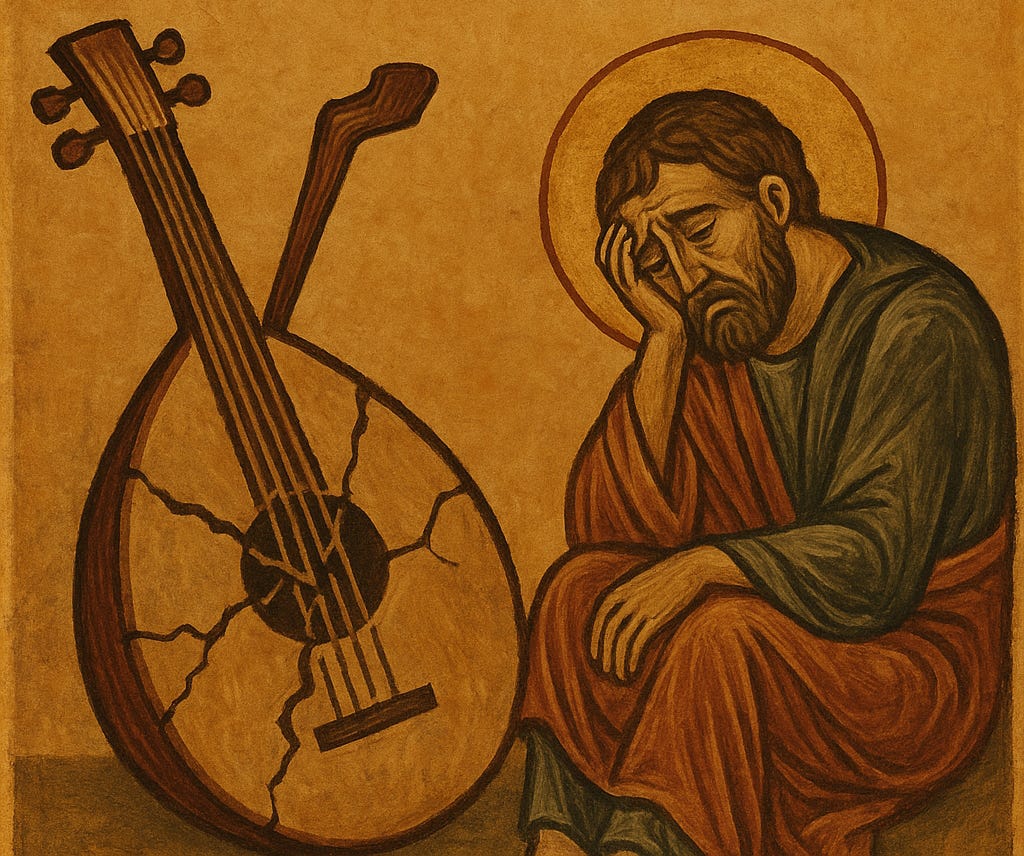
“Keep thy mind in hell and do not despair.” ~ St. Silouan the Athonite
Today, when more than one in ten Americans takes antidepressants and about as many see a therapist, clinical language has begun to shape how we understand ourselves. Sadness becomes “depression;” unease becomes “anxiety;” relational conflict becomes “emotional damage.” To have one’s feelings dismissed is to be “emotionally scarred.” We speak as though to be human were already to be wounded, and as though life itself were a continual journey toward emotional well-being.
Within such a culture, it becomes difficult to imagine the Eastern Orthodox mindset—where experiences typically regarded as psychological are understood instead as spiritual in origin.
This is almost incomprehensible to the modern mindset. We think in terms of chemicals and neural activity, brain and behavior. We no longer inhabit a world alive with angels and demons, hierarchies and saints, but one cordoned off like a dig site—each grid labeled, mapped, and categorized. Our sufferings are sorted by type in the DSM-V, treated as defects of circuitry and medicated into manageable proportions. Within such a frame, the ancient language of the Church—of logismoi, those thoughts sown by the enemy, which enter the heart and cause one to contract a spiritual illness that can be healed only through spiritual medicine—must sound medieval and superstitious to the modern ear. Yet it is precisely this world the Church still inhabits: a world charged with God, demons, and the possibility of deification.
And in inhabiting this world, the entire frame of reference shifts—not only the nature of things, but the nature of life itself, how one orients one’s actions, and toward what end. For the Orthodox Christian, this means occupying a stance of constant spiritual warfare. Within this framework, what we would now call psychological distress is interpreted as part of a larger spiritual battle and often as the machinations of demons. The Philokalia—the Church’s DSM-V—offers a complete nosology of these interior disorders and prescribes spiritual treatments in place of modern therapies. Depression is cast as despondency, sorrow, or despair—conditions that begin with a single logismos entering the mind and settling in the heart, where it grows into a spiritual illness.
Sadly, this has, in some cases, led certain priests and ascetics—and now, many Orthobros—to become antagonistic toward or dismissive of those who receive psychiatric treatment. Yet as Eastern Orthodox patristic scholar Jean-Claude Larchet argues in Mental Disorders and Spiritual Healing: Teachings from the Early Christian East, the authentic Orthodox tradition never wholly separates the spiritual from the physical. It recognizes that illness can arise from bodily disorder as much as from spiritual affliction.
The Testimony of the Fathers
This insight appears most beautifully in the revered fourth-century Father of the Church Gregory of Nyssa’s On the Human Image of God. To describe the relation of intellect to body, Gregory likens the body to a flute and the intellect to the musician who breathes through it. When the instrument is cracked, he says, the player cannot “demonstrate his prowess,” because “that which is destroyed by time or broken… is mute and inoperable.”1 The breath still passes through, but the sound betrays the damage of the instrument. So too the intellect may act rightly in itself, yet when the bodily organ is impaired its music becomes dissonant.
Thus, when the bodily instrument is “removed from its nature” by corruption, it fails to respond to the movement of the intellect.2 The intellect may act upon different parts of the body, but those parts that are bent or dysfunctional sound out of tune, so that even the proper activity of the intellect becomes ineffectual. The “breath” of the intellect may still pass through the instrument of the body, yet the sound it yields betrays the damage or malformation of that instrument insofar as it has been removed from its nature.
Through head injuries, neurological disorders, or other impairments, one’s intellect may therefore remain intact and uncorrupted—acting rightly in itself—while the corruption of the body subverts its natural powers from acting according to their proper function. The result may be what we now recognize as intellectual disability, mania, or depression: conditions in which a person’s behavior departs from what is natural or good, not necessarily because the intellect has fallen into sin or come under demonic influence, but because part of the bodily instrument—the brain, for instance—has been rendered defective. Such a person may therefore suffer profoundly and even act in ways that appear confused or destructive, yet without moral culpability or spiritual corruption as the cause.
A Contemporary Witness
If Gregory of Nyssa helps us understand severe mental illness through the image of a broken instrument, the contemporary saint, St. Paisios the Athonite (†1994), adds to it a personal dimension, allowing us to see more clearly what this “broken instrument” means for us in practical terms.
He does this in a story he tells one of his spiritual children, about a young man who would come visit him at the Panagouda. Every six months or so, the boy would show up all “mixed up,” and the Elder would have to put him back together again. Seeing his distress, the saint said that God would not hold him fully responsible for his actions.3 Everything in the boy was unsettled—his thoughts, his emotions, his very sense of himself. Yet within this confusion, St. Paisios saw not moral failure, but suffering.
When asked about him, the Elder said simply that the young man was “extra sensitive.” By that he did not mean a flaw of character to be corrected by willpower or stoicism, but a simple reality—that things affected him more deeply than most, that he felt the world with an intensity others could scarcely bear.4
In this, St. Paisios revealed the same truth Gregory had expressed in figure: that even when the instrument is damaged, the soul’s essence remains largely—if not completely—untouched. And more than that, he articulated something profoundly true of mental illness. Those who are bipolar, along with those suffering from grave nervous disorders, depression, or trauma, are often exceptionally sensitive to things that would simply pass over others. Add this to the increasing pace, overstimulation, and pornographic quality of the modern world, and you have a world the mentally ill were never made to inhabit.
Who Fits the Bill
Now, returning to the claim that those who suffer from severe mental illness may be, in some hidden way, holy—or even saints—I can see how such a statement might have stirred something in many readers. Set alongside the words of Gregory of Nyssa and St. Paisios, it could prompt some to imagine that taking an antidepressant or struggling with social anxiety somehow places them among the saints. Though I empathize with such conditions, I must, for a number of reasons, caution against treating them as signs of inner sanctity.
To fit the bill of the kind of person I am speaking about, one must have truly lost the ability to show the world their self, for it has been masked—or taken—from them. Such a person is so disabled by illness that they can no longer function in ways most people consider necessary for ordinary existence. It is to experience the suffering of losing the ability to appear to others as a real person rather than as a diagnosis. It is to be stripped of the things that make life meaningful and give us reasons to move forward. It is to wander through a foreign city, to live in a different reality, often cut off entirely from this world.
This Mental Illness, As Far As I Know It
To be mentally ill as I am talking about it is to have many people tell you, “I miss you — I miss seeing you, the real you,” and to know they only catch a glimpse of it once in a while. And this is not because you tried to become someone else, but because you went psychotic and hallucinated and dissociated for so long that, by the time you came back, you no longer knew who you were or what you were. You heard the things you had done during the manic episode only through witnesses, and so unable were you to match that person to the one you thought you were that you traded your memory for the ability to continue to exist on this planet.
Your memory of staying at home and watching your daughter for the first two years of her life — everything after the nurse laughed because you kept crying out through tears, “She’s so beautiful,” the moment she came into this world.
Your memory of your son being born and nearly every milestone afterward, until he suddenly began to look at you like he wanted to be you.
Your memory of whatever you wrote more than a week ago, and any sense of how it relates to the present.
And even then, that was not enough. The medicine you take to stay safe and not act out robs you of the ability to be present with your children. It forces you to accept that you cannot expect to experience pleasure or happiness ever again — or even to resemble what most people mean when they say “a person.” The only reason you stay alive is because you know that children who grow up with a father who kills himself are a thousand times more likely to do it themselves, and you want them to have the happiness and personhood you yourself have been denied.
And none of this necessarily means anything about me—I will not claim for myself any sanctity or pretend I deserve anything but hell; and yet, I did have one experience, a long time ago, before I got worse, which showed me the possible purifying effect of suffering.
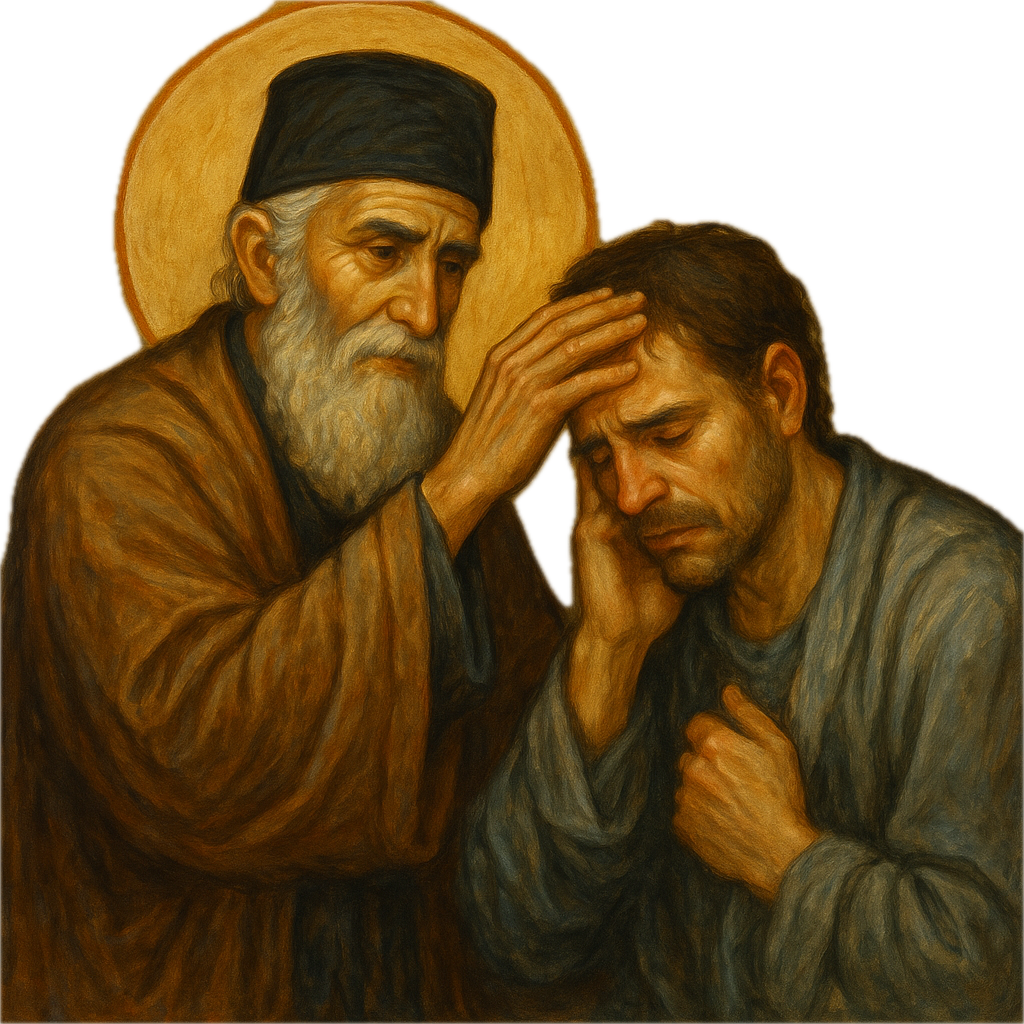
I had been consumed by the great black nothing with the pressure on my chest growing until I thought my ribs would crack open or I’d be turned inside out. I prayed the Jesus Prayer with all my strength, but it seemed not to help. One day passed. Then another. By the third day, I had all but given up hope of any heavenly aid. And it was then that I was visited by St. Paisios.
It wasn’t my imagination. I saw him noetically, and everything I had ever read about him was there: the knit cap; the playful, almost childlike joy; that strange wholeness saints have, as if their love carried weight. He bopped me on the nose, and at once something broke open inside me. A warmth — a love not of this world — flooded through me as he reached into my soul and began setting things in place. In an instant the tension fled, and I felt weightless. Tears began to leak out of their own accord, and all I could feel toward him was love.
Who knows how to truly explain such things, except for this one truth I could sense from his love: that his Joy—the Divine Joy of Christ—was only acquired by never holding onto it, but giving it away as much as possible until you’re empty, because you can’t bear the thought of others not having it, and in this way it reproduces itself, ever expanding—refilling one’s tank every time one goes on a bit past empty.
And if this is the heart of life—that you receive only in giving it away—then I hope God will know that I offer Him my soul and more than I am able to give. I will stay alive for the rest of my years without a reason or purpose, except to spare my family and children the suffering that not staying alive would bring them.
Gregory of Nyssa, On the Human Image of God, trans. John Behr (Oxford: Oxford University Press, 2023) 12:8. Also see 12:4, “We know that mental aberrations do not occur from heaviness of head alone, but those skilled in the healing art declare that the discursive faculty is also similarly weekend when the membranes undergirding the sides are affected by disease calling the disease ‘frenzy’, since the name given to those parts is ‘wits.’” Frenzy comes from the ancient word φρενῖτις (phrenitis) meaning inflammation of the brain and was associated with delirium or madness.

Ibid.
This story is recounted in one of the Saints Spiritual Councils. Unfortunately I cannot locate it, but my guess is it is in With Pain and Love for Contemporary Man or Spiritual Awakening.
Ibid.
I pray that you find some meaning and purpose in your writing as well. I have my own mental health struggles, and your work has meant a lot to me in recent months.